

How Can I Stimulate My Brain Without Drugs? Try these science-backed habits to strengthen memory, focus better, and stay sharp.
You can stimulate your brain without drugs by pairing regular exercise, focused learning, solid sleep, and steady stress control.
These habits raise neuroplasticity, sharpen memory, and improve attention over time. Research from Harvard Medical School shows consistent routines beat quick cognitive tricks when you look at long-term results.
The goal is not a sudden jolt. It is gradual change that builds. Support brain-derived neurotrophic factor, blood flow, and stronger neural connections with simple daily choices. Do it often, track what helps, and adjust. Keep reading to see what works in practice and how to fit it into your day daily.
Brain Boost Essentials – Daily Brain Boosters
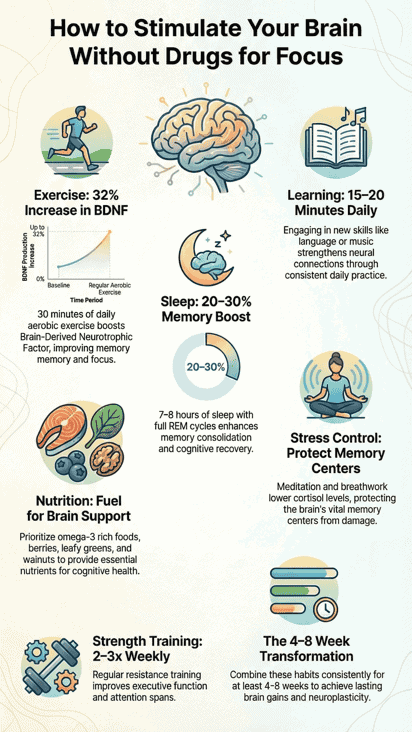
- Daily habits like exercise and learning can raise BDNF by up to 32% and improve memory over several weeks.
- Combining physical activity, cognitive challenges, and proper recovery outperforms single “brain hacks.”
- Consistency over 4–8 weeks leads to clearer focus, faster thinking, and steadier mental clarity.
Taken together, these points show that small, repeatable actions, done consistently, compound into noticeable improvements in overall brain performance.
Quick Wins for Brain Stimulation Without Drugs
Natural brain stimulation relies on exercise, learning, sleep, and stress control to boost neuroplasticity and cognitive performance without chemicals. Many people exploring ways to enhance cognitive function focus on combining these habits rather than relying on isolated methods.
Three habits deliver fast, measurable effects. 30 minutes of aerobic exercise increases BDNF levels by up to 32%, according to Harvard Medical School, improving memory formation and focus within weeks.
Learning new skills such as a language or musical instrument activates multiple brain regions at once. This strengthens synaptic connections and builds long-term cognitive reserve, which protects against decline.
Sleep remains the most overlooked factor. Getting 7–8 hours with REM cycles improves memory consolidation by up to 30%, based on findings from National Sleep Foundation research.
To apply quickly, focus on these actions:
- Walk or cycle for 30 minutes daily
- Practice a new skill for 15–20 minutes
- Protect 7–8 hours of sleep
These three alone shift brain performance within a month.
Why Brain Stimulation Without Drugs Works
Credits: RESPIRE Health
It works by increasing blood flow, strengthening neural connections, and enhancing neuroplasticity through repeated mental and physical engagement. This is why interest in a natural nootropic approach continues to grow, as it aligns with how the brain adapts through consistent stimulation.
Data from PubMed Central (PMC) / NIH demonstrates
“The vast majority of these substances are of natural origin, not subject to prescription, and can usually be easily obtained in the form of food supplements or herbal extracts. [They] improve human thinking, learning, and memory. Many of these formulations possess antioxidant activity that protects brain tissue from neurotoxicity and improves the brain’s oxygen supply.” –Nutrients
The brain adapts to stimulation through neuroplasticity, the process where neurons form new connections. Repeated exposure to learning or movement strengthens these pathways, improving speed and accuracy.
Physical activity increases oxygen delivery and triggers BDNF, a protein that supports neuron survival and growth. Studies cited by the National Institutes of Health (NIH) show BDNF can rise 20–40% with regular exercise.
Cognitive challenges activate the prefrontal cortex and hippocampus. These regions control memory, decision-making, and attention. Over time, repeated activation increases efficiency and resilience.
Stress reduction also plays a role. Lower cortisol levels protect memory centers from damage and improve emotional regulation.
According to the NIH, “repeated stimulation strengthens neural circuits,” reinforcing the idea that consistency, not intensity, drives long-term results.
How Physical Exercise Boosts Brain Function
Aerobic and resistance training enhance memory, focus, and mood by increasing oxygen flow and stimulating neuron growth.
Aerobic workouts such as running and cycling increase hippocampus volume, the brain area tied to memory. Research shows 3–5 sessions weekly improve memory by ~15%.
Strength training adds a different benefit. It improves executive function, including planning and attention, by activating the frontal cortex.
Psychiatrist Dr. John Ratey of Harvard links exercise directly to mental clarity, calling it “fertilizer for the brain” in clinical discussions.
Regular movement also reduces inflammation and improves insulin sensitivity, both linked to better cognitive performance.
Here is a clear breakdown:
Exercise Type | Brain Benefit | Frequency |
Cardio | Memory, BDNF increase | Daily |
Strength | Focus, executive function | 2–3x/week |
To maximize results:
- Combine cardio + strength training
- Include balance activities like tai chi or dance
- Aim for 150 minutes weekly
This combination supports both short-term alertness and long-term brain growth.
Cognitive Challenges That Improve Brain Performance

Learning complex skills and solving problems strengthens neural pathways and builds long-term cognitive resilience.
Challenging the brain forces it to adapt. Studies from University College London (UCL) show learning a new language can increase brain density by ~4% in key regions.
Activities like chess, puzzles, and music activate multiple neural systems at once. This builds stronger and more flexible connections across the brain.
Skill-based learning also improves working memory and attention span. For example, playing piano enhances coordination while reinforcing memory sequences.
To build cognitive strength, include a mix of tasks:
- Logic challenges like sudoku and chess
- Creative skills like music or writing
- Memory drills such as mental math or memorizing poetry
Short daily sessions of 15–20 minutes are enough to trigger adaptation. Over time, these activities increase processing speed and decision-making ability.
Nutrition and Sleep to Enhance Brain Stimulation

Proper nutrition and sleep restore brain function, improve memory consolidation, and regulate cognitive performance.
The brain uses about 20% of the body’s energy, making nutrition critical. Omega-3 fatty acids from fish or walnuts support neuron structure and communication.
Foods rich in antioxidants, such as blueberries and dark chocolate, protect against oxidative stress. Compounds like flavonoids improve blood flow to the brain.
Sleep acts as the brain’s repair system. During REM cycles, memories are consolidated and toxins are cleared. Studies show 7–9 hours improves recall by 20–30%.
According to the World Health Organization (WHO), sleep and nutrition directly influence cognitive health and long-term brain resilience.
For practical optimization:
- Eat omega-3 rich foods like fish and walnuts
- Include leafy greens and berries daily
- Limit sugar to avoid energy crashes
- Maintain consistent sleep timing
For deeper reading, see guidance from Harvard Health:
https://www.health.harvard.edu/mind-and-mood/foods-linked-to-better-brainpower
And sleep research from the CDC:
https://www.cdc.gov/sleep/about_sleep/how_much_sleep.html
These habits compound over time, improving both clarity and mood.
Meditation and Stress Reduction Techniques That Work

Meditation improves focus and emotional regulation by reducing cortisol and strengthening brain regions tied to attention.
Regular meditation changes brain structure. Research from Massachusetts General Hospital shows 8 weeks of practice increases gray matter density in memory and learning areas.
Mindfulness training improves attention control by stabilizing brain wave patterns, especially alpha waves (8–12 Hz) linked to relaxed focus.
Stress reduction plays a major role. Lowering cortisol by ~30% protects the hippocampus and improves recall.
Simple techniques include:
- 10 minutes daily meditation
- Breathwork like pranayama
- Progressive muscle relaxation
These practices also improve emotional stability, which supports better decision-making and sustained concentration.
Effectiveness of “Biohacker” Techniques Like Cold Showers
Some techniques like cold exposure and sensory stimulation may improve alertness, but evidence varies and consistency matters more.
Research from ResearchGate shows,
“Natural nootropics, derived from plant-based sources, have long been used to enhance cognitive function. Coined by Corneliu Giurgea in the 1970s, the term ‘nootropic’ refers to compounds that positively affect the mind, particularly in areas such as memory, attention, motivation, and learning. Unlike synthetic agents, natural nootropics offer neuroprotection with minimal toxicity and side effects.” –Natural Nootropics and Cognitive Enhancement: A Critical Review
Cold showers trigger a stress response that increases dopamine and alertness. This aligns with ongoing interest in what can increase dopamine naturally through behavioral and environmental triggers. Some reports suggest a ~20% boost in perceived energy, though controlled studies remain limited.
Online communities often highlight routines such as intermittent fasting, binaural beats, or sensory deprivation. These methods can support focus but depend heavily on individual response.
Real-world feedback shows improvements often appear after 30 days of consistent practice, not immediately.
Common approaches include:
- Cold exposure for alertness
- Nature walks for mood and focus
- Sensory challenges like blind taste tests
These techniques can complement core habits but should not replace exercise, sleep, and learning.
Advanced Methods Like tDCS and Their Impact
Non-invasive brain stimulation like tDCS shows potential for memory improvement but remains experimental and not widely recommended.
Transcranial direct current stimulation (tDCS) uses low electrical currents to influence brain activity. Early studies show 10–20% improvements in learning speed under controlled conditions.
Research from Stanford University suggests benefits in specific tasks, especially when paired with training. However, results vary and long-term safety is still under review.
Limitations include:
- Inconsistent outcomes across individuals
- Limited access outside research settings
- Lack of long-term data
For most people, lifestyle-based natural nootropics remain safer and more reliable.
FAQs
What daily habits help stimulate the brain naturally without drugs?
You can stimulate the brain naturally by combining daily habits that support mental performance. Regular aerobic workouts BDNF, weight training for mental clarity, yoga for brain plasticity, meditation to boost alpha waves, and mindfulness focus training all strengthen neural connections. Getting 7–8 hours REM sleep and taking short power naps for memory consolidation supports brain repair. Eating omega-3 fatty acids, walnuts, blueberries, and leafy greens further enhances focus and long-term cognitive function.
How can exercise neurogenesis and running hippocampus growth improve memory?
Exercise neurogenesis promotes the creation of new neurons, while running increases hippocampus growth, which strengthens memory and learning areas. Combining aerobic workouts with weight training mental clarity, tai chi balance brain exercises, and mind-challenging activities like dual-n-back training or chess improves cognitive performance. Even short, consistent daily sessions create measurable improvements in focus, BDNF levels, and overall mental clarity without using drugs.
Which natural nootropics lifestyle choices enhance focus and learning?
A natural nootropics lifestyle involves eating brain-supportive foods and engaging in mental challenges. Omega-3 fatty acids from fish, walnuts, blueberry antioxidants, dark chocolate flavonoids, green tea L-theanine, and turmeric curcumin reduce inflammation and support brain health. Leafy greens vitamin K and beets nitrate blood flow improve circulation. Pair these foods with learning a new language, playing a musical instrument, or practicing mindfulness focus training to boost cognition and improve memory without drugs.
Can meditation alpha waves and mindfulness focus training boost brain power?
Meditation that stimulates alpha waves and mindfulness focus training improve attention, memory, and emotional control. Daily practices such as breathwork pranayama oxygen, gratitude practice positivity, and progressive muscle relaxation reduce stress and strengthen neural connections. Combining these activities with aerobic workouts BDNF, weight training mental clarity, and 7–8 hours REM sleep promotes neuroplasticity and long-term cognitive performance without relying on drugs.
How do sleep brain repair and 7–8 hours REM improve mental clarity?
Sleep supports brain repair, consolidates memories, and clears toxins. Achieving 7–8 hours REM sleep each night and taking occasional power naps memory consolidation improves focus, recall, and problem-solving skills. Pairing quality sleep with aerobic workouts BDNF, weight training mental clarity, yoga brain plasticity, and a natural nootropics lifestyle ensures consistent improvement in cognition and mental clarity without using drugs.
Keep Your Brain Sharp Without Shortcuts
You know how frustrating it is to try a new trick and see nothing happen. Your focus dips, memory slips, and it feels like the effort is wasted. The reality is that quick fixes rarely stick. Real improvement comes from steady habits that target your brain from multiple angles.
nootropicmax can make this easier by helping you track your daily routines and keep consistency. Using it alongside regular exercise, learning challenges, and sleep routines lets you see real gains, not just temporary spikes. Small, consistent steps become automatic, and over time your brain works better without extra effort.
References
- https://pmc.ncbi.nlm.nih.gov/articles/PMC9415189/
- https://www.researchgate.net/publication/393600400_NATURAL_NOOTROPICS_AND_COGNITIVE_ENHANCEMENT
Related Articles
- https://nootropicmax.com/how-to-enhance-cognitive-function-with-nootropics/
- https://nootropicmax.com/what-is-a-natural-nootropic/
- https://nootropicmax.com/what-nootropic-increases-dopamine